
Yes, and…

This post is the third in an accidental mini-series on creativity, which started out derivative, took a turn through the need for a certain stupidity, and now goes slightly mad.
The accident is apt, in context: Kentridge writes in praise of the folly that neglects to plan things in advance, “making a space for uncertainty, for giving an impulse, an object, a material, the benefit of the doubt.” Apt, too, that I am thinking with a book, like Daniel Karlin or Charles Lamb, and that the book—by the legendary improv teacher, Keith Johnstone—says this about its craft:
The improviser has to be like a man walking backwards. He sees where he has been, but he pays no attention to the future. His story can take him anywhere, but he must still ‘balance’ it, and give it shape, by remembering incidents that have been shelved and reincorporating them. Very often an audience will applaud when earlier material is brought back into the story. They couldn’t tell you why they applaud, but the reincorporation does give them pleasure. Sometimes they even cheer!
Ideally, a callback ought to be more artful than my opening line. (No cheering; hold the applause.) But I have backed into a theme, and having introduced material without design, it is my job, somehow, to balance it.
Johnstone started out as a playwright but was stymied by writer’s block. He became a theatre director, only to be stricken by the less well-known director’s block. Teaching drama was his way out—and what he taught was “impro.”
Johnstone blamed his own creative limits on his schooling and came to think of adults as “atrophied children … bitter, uncreative, frightened, unimaginative, and rather hostile people.” His genius was to find ways to “make the world blaze up again.”
For example, if I have a group of students who are feeling fairly safe and comfortable with each other, I get them to pace about the room shouting out the wrong name for everything that their eyes light on. Maybe there’s time to shout out ten wrong names before I stop them. Then I ask whether other people look larger or smaller—almost everyone sees people as different sizes, mostly as smaller. ‘Do the outlines look sharper or more blurred?’ I ask, and everyone agrees that the outlines are many times sharper. ‘What about the colours?’ Everyone agrees there’s far more colour, and that the colours are more intense. Often the size and shape of the room will seem to have changed, too.
I can’t attest to this effect, but I have instinctively used one of Johnstone’s other tactics, which is to pull oneself up by one’s creative bootstraps:
It’s possible to turn unimaginative people into imaginative people at a moment’s notice. I remember an experiment referred to in the British Journal of Psychology—probably in the summer of 1969 or 1970—in which some businessmen who had showed up as very dull on word-association tests were asked to imagine themselves as happy-go-lucky hippy types, in which persona they were retested, and showed up as far more imaginative.
I haven’t been able to locate the article Johnstone cites—if you know it, share the reference—but I did find a 2016 paper in which undergraduates were asked to imagine being either “eccentric poets” or “rigid librarians” and then given a “Uses of Objects Task,” with predictably dichotomous results. If you have even a little imagination, you can successfully pretend to have more. My only caution is: don’t iterate the process; this could trigger the creative singularity.
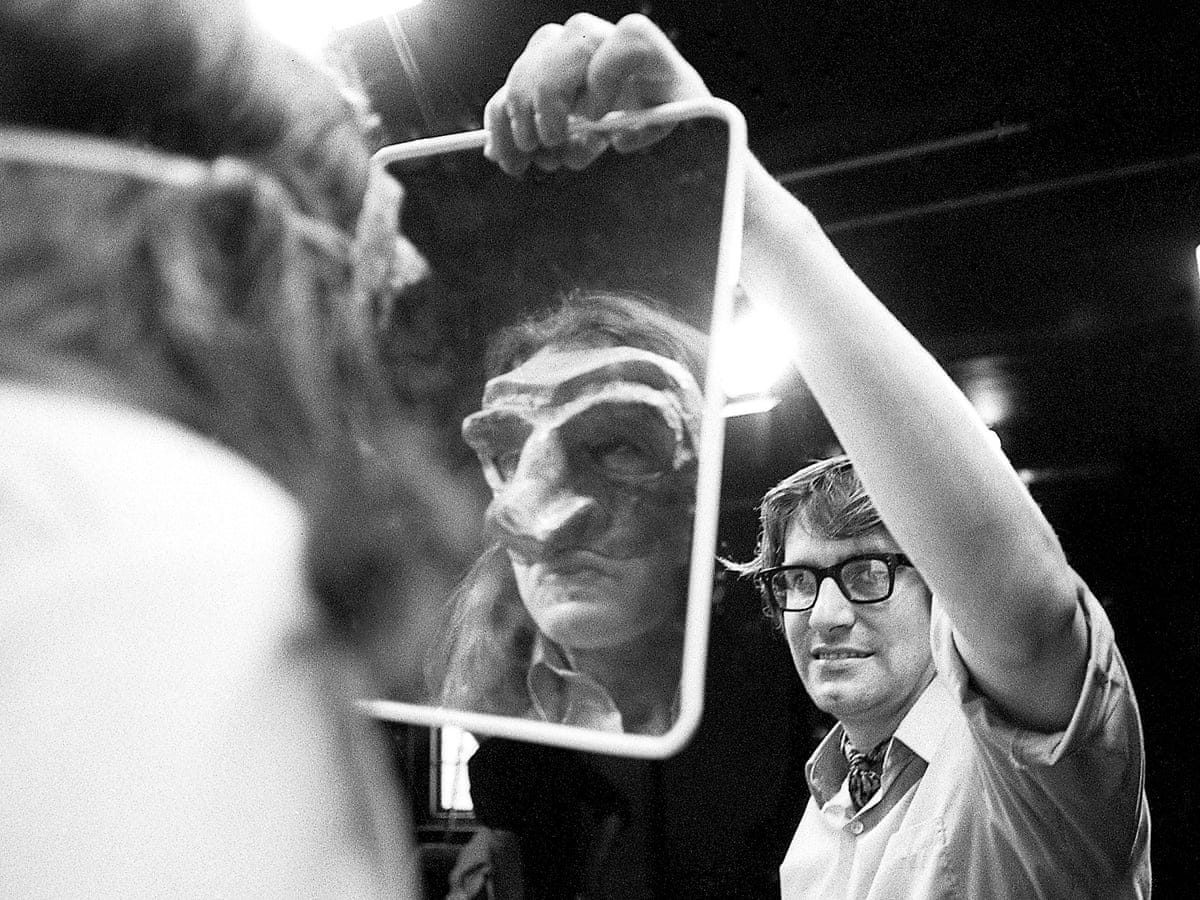
Despite having dabbled in stand-up comedy, I find the idea of improv terrifying, like working the circus trapeze without a net or basic gymnastic training.
One of Johnstone’s most profound ideas, I think, is that we are inhibited by the idea of art as “self-expression”—and that we can disinhibit ourselves by thinking of ourselves as its medium, not its source. “Once we believe that art is self-expression,” he writes, “the individual can be criticised not only for his skill or lack of skill, but simply for being what he is.” If I am exposed in what I say and do on stage, I am at risk of shame—and may be tempted by the pride of “novelty.” For Johnston, originality must go the way of self-expression:
You have to trick students into believing that content isn’t important and that it looks after itself, or they never get anywhere. It’s the same kind of trick you use when you tell them that they are not their imaginations, that their imaginations have nothing to do with them, and that they’re in no way responsible for what their ‘mind’ gives them. In the end they learn how to abandon control while at the same time they exercise control. They begin to understand that everything is just a shell. You have to misdirect people to absolve them of responsibility. Then, much later, they become strong enough to resume the responsibility themselves. By that time they have a more truthful concept of what they are.
There are hints, here, of a metaphysics I do not believe. “When you act or speak spontaneously,” Johnstone argues, “you reveal your real self, as opposed to the self you’ve been trained to present.” But it’s all me: the parts of us that are revealed in how we present ourselves to others aren’t unreal; and our unreflective thoughts are no more true to us than our reflective ones.
Still, you don’t need to accept the True Self to see that we’re inhibited and that our inhibitions limit us creatively. For Johnstone, “the ‘personality’ [is] a public-relations department”; it’s always “functioning, at some level, in terms of what other people think.” If you grant this stipulation, you can imagine impro as short-circuiting personality—and the fear of impro as a fear that what lies behind the PR is insanity or worse. Here Johnstone echoes Thomas Hobbes:
Johnstone: “My feeling is that sanity is actually a pretence, a way we learn to behave. We keep this pretence up because we don’t want to be rejected by other people—and being classified insane is to be shut out of the group in a very complete way.”
Hobbes: “the most sober men, when they walk alone without care and employment of the mind, would be unwilling the vanity and extravagance of their thoughts at that time should be publicly seen; which is a confession that passions unguided are for the most part mere madness.”
Insanity as the True Self? Creativity as madness? I am not convinced. But it may not matter. Even if none of it is true, we can pretend it is, like laid-back hippies or quirky poets—and when it comes to imagination, pretence is as good as fact.
Do you think there’s a similar role for disinhibition in philosophy? If I thought my papers were an expression of my True Self, I’d probably overthink every publication.
On folly: “The soul demands your folly, not your wisdom.” Carl Jung (epigraph to my novel).
On sanity: “Your conscious thoughts sit out on the front porch in their Sunday best, waving to passersby, while inside the house your subconscious thoughts are jumping around like the Three Stooges on Pogo Sticks and acting crazy.” (From my novel, Divine Madness - The Quantum Mechanics of the Soul, as much a work of philosophy as of fiction.)