
(Untitled)

Having reached the end of punctuation, I determined that the alphabet was next—only to be diverted by Peter Schwenger’s eye-opening book, Asemic: The Art of Writing.
Deriving from the work of Roland Barthes and Jacques Derrida, the word “asemic” means literally “without sign,” which could mean without meaning—“sign” plays on the ambiguity of signified and signifier—but in the hands of visual poets Tim Gaze and Jim Leftwich, becomes a term for visual art that mimics the appearance of script without the use of recognizable letters or words.
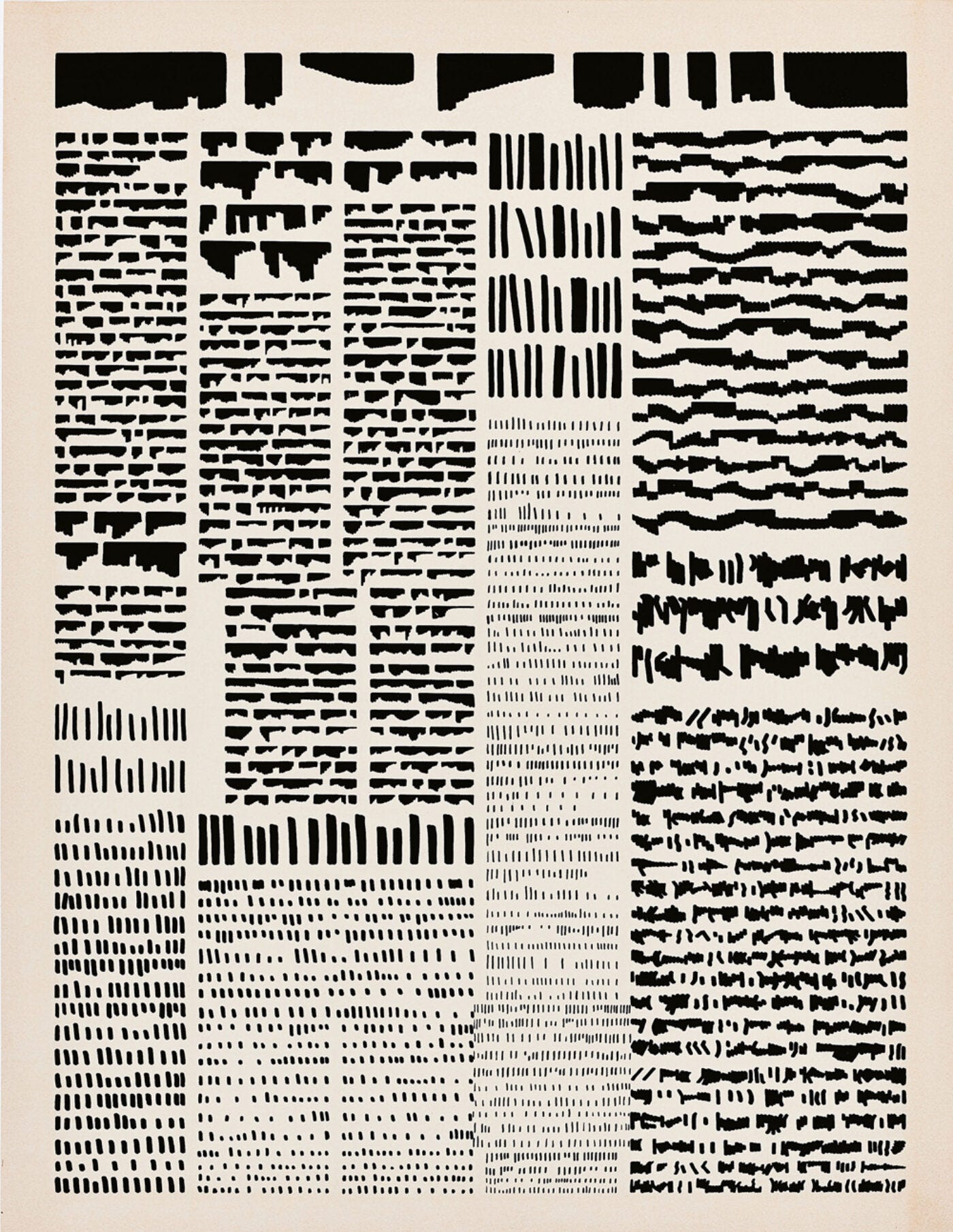
Asemic works typically simulate cursive handwriting or hieroglyphics, but they also play with the printed word, as in this newspaper front page by the Argentine artist Mirtha Dermisache…
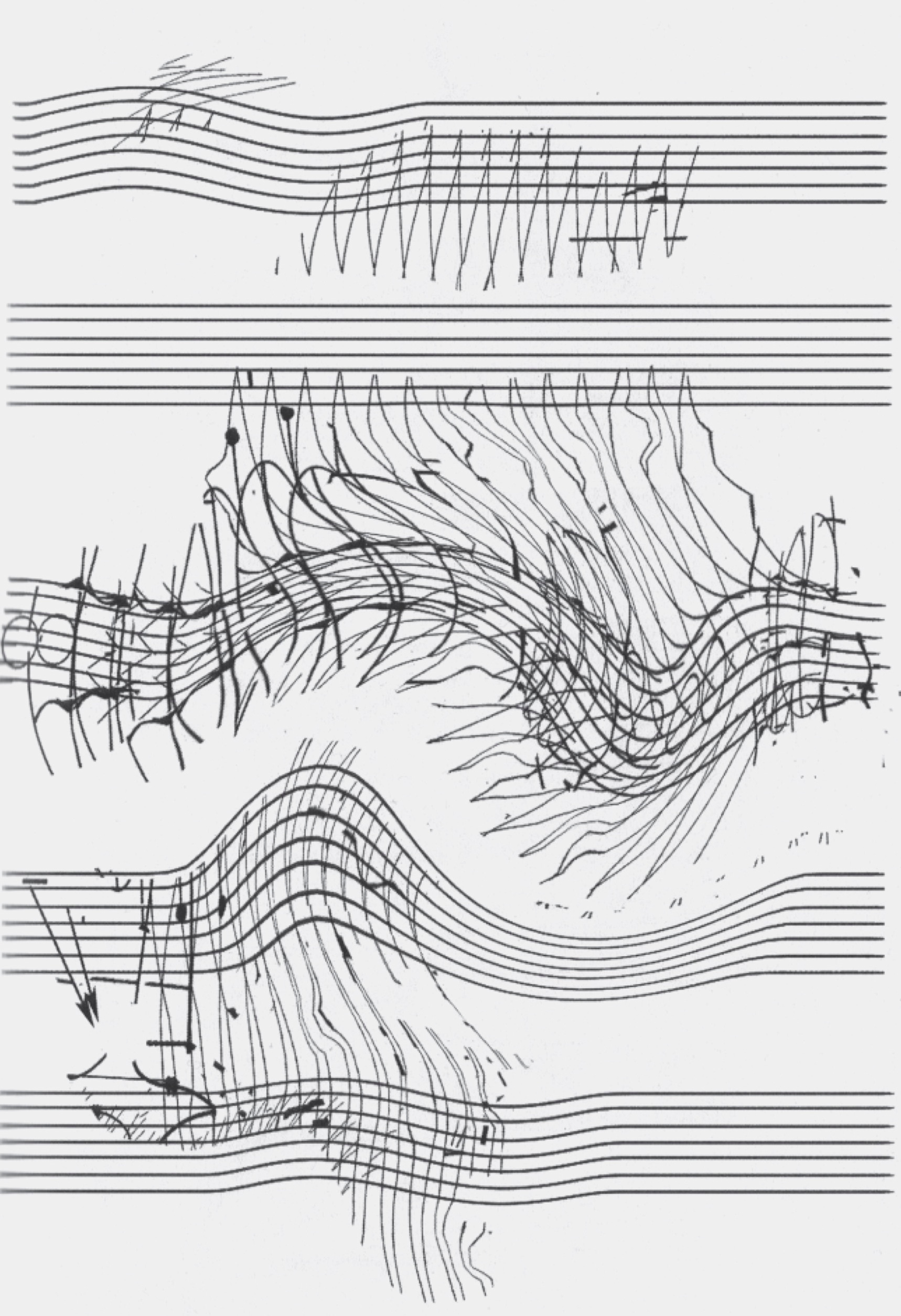
… and with musical scores, as in Rosaire Appel’s Seesongs:
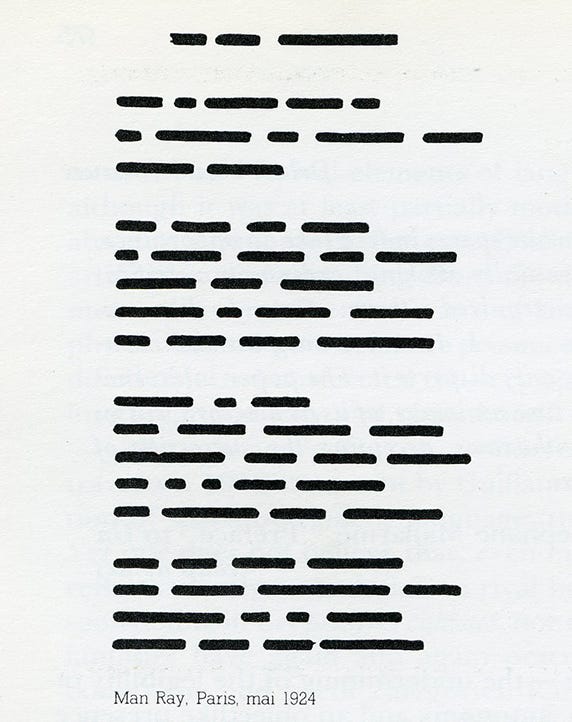
The earliest precursors of asemic art are Man Ray’s 1924 Poem, pictured below, and more systematically, the work of the French poet and painter Henri Michaux, closely followed by Barthes, Dermisasche, and Cy Twombly, and later, contemporary asemicists Appel, Xu Bing, Wenda Gu, Michael Jacobson, and Christopher Skinner.
I don’t envy Peter Schwenger the task he set himself in Asemic. It’s not easy to write about conceptual art without undue abstraction, and paintings that resemble writing but aren’t are no exception. Schwenger is most articulate about the work of Michaux, perhaps because Michaux articulates himself.
Michaux’s attitude toward signs is emotional, a combination of rage and desperation as he tries to get past the conventional expectations of the page to something that he himself does not yet know. More than an emotional attitude, though, it is a philosophical one.
For Michaux (in his own words) the aspiration of asemic art is “To grasp while abstracting yourself ever more, to grasp the tendency, the accent, the pace, the space. To grasp the underlying.” Schwenger translates for us:
What began in particulars has ended in abstractions, a trajectory that is surely at the core of philosophy. … It is through signs, then, that Michaux attempts to translate “the underlying,” that which is beyond our usual perceptions, and our usual words. These are themselves translations, inadequate ones, though they are not generally recognized as such. Yet, Michaux asserts, “everything is translation at every level, in every direction.” This is already the case.
The argument, if I understand it properly, is that asemic writing points towards the ineffable, which could only be expressed by an impossible script, in the language of the Forms or noumena—and yet it is, in another way, just like ordinary text, which is thereby outed as no more articulate about reality in-itself than uninterpretable scrawl.
That’s a plausible reading of Michaux—when it comes to the artist’s intent, I’m happy to take him at his (non-)word—but it’s hard not to sense that it’s under-determined. This comes out in the fact that the reading could apply to the genre as a whole, abstracting from the differences between specific works, which may vary from a single sheet of paper to an epic that runs 500 pages, like Dermisache’s 1967 Libro N° 1. It comes out, too, in the plausibility of an exactly opposite interpretation: asemic writing, like comedy for Terry Eagleton, “represents a momentary respite from the tyrannical legibility of the world”—in particular, of the texts that surround and interpellate us, saturating our lives with sense.
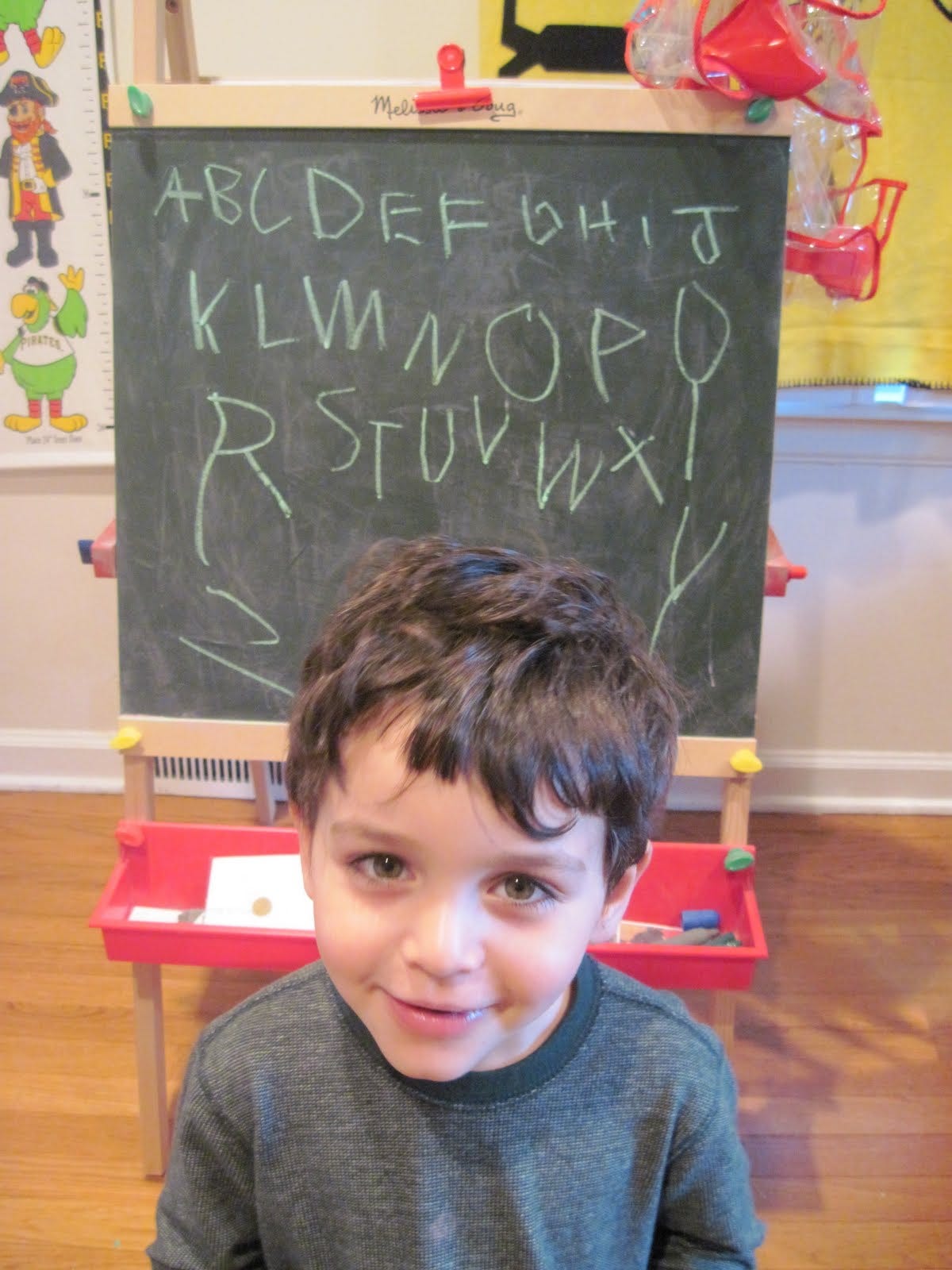
When I look at certain works of asemic art, I experience a retreat from meaning, a regression, not an aspiration to say what cannot be said. They represent an inverse of the blackboard from my daughter’s room, when she first proudly reproduced the Latin script, embarked on a one-way journey into literacy:
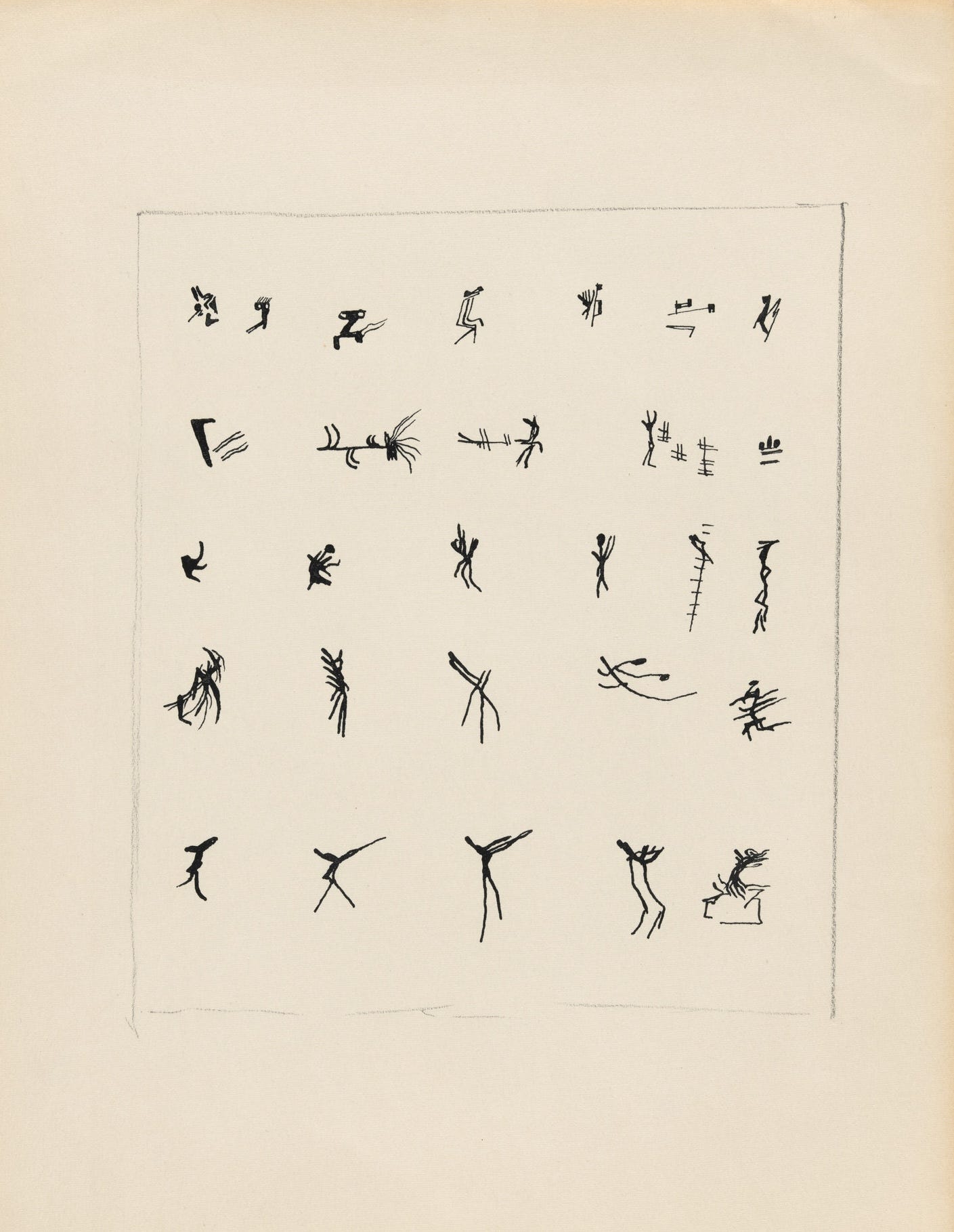
Take the “imaginary alphabets” of Peter Mendelsund, featured in his memoir, Exhibitionist:
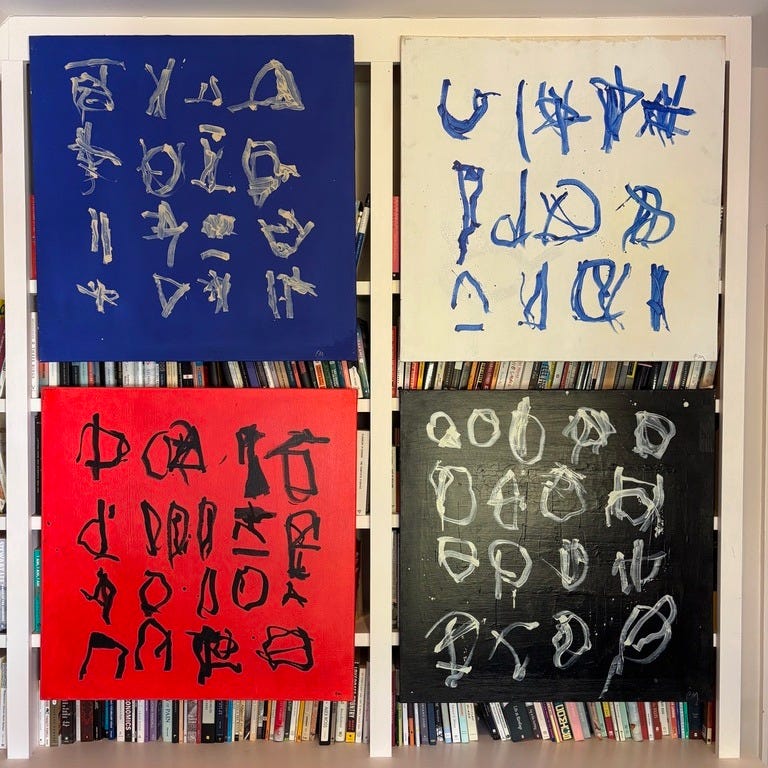
The unsteady hand, the spatter, the occasional uncertain repetition, the coloured backdrops: they remind us that handwriting is no more than drawing on a page, the written alphabet pictorial marks. diligently and imperfectly reproduced. We are aging backwards, from a time of oppressive intelligibility to a pre-textual world in which letters cease to be letters, words cease to be words, and all sound becomes music.
The Mendelsund paintings live in my study at home, where there is no wall space left for art. In retrospect, it was fitting that I had to hang them on the bookshelves, obstructing access to the written word—or protecting me against it.
The Man Ray looks like a redacted Epstein file.
Xu Bing is an interesting case, because after his Book from the Sky, which is smack in the center of the asemic canon (as you've described it, not a category I had conceptualized before reading this) he went on to write The Book from the Ground, which is the opposite: no language but utterly legible, written in symbols which aren't words nor standardized but which are perfectly comprehensible (which would be interesting to consider alongside emoji, although I think his book predates emoji, but maybe it just predates my own knowledge of them; at any rate he's not writing in emoji, it's cooler and weirder). (I go on about it here: stephenfrug.blogspot.com/2011/07/xu-bings-book-from-ground.html) Opposite in another way is a third project (done after the sky and before the ground) called Square Word Calligraphy, which at first glance looks (to non-Chinese readers) illegible—it looks like Chinese—but which, once examined closely, turns out to be strangely shaped English letters which can be read. Having made these transitions (text that looks like Chinese but is actually asemic, text that looks Chinese but is actually English, and then text that looks like nothing but is actually a narrative) throws an interesting light on the asemic project, I think.