Snookered
If this all sounds feasible, or even fun, then I’m afraid my description has been misleading.
The description in question is by Sally Rooney, in an essay in the New York Review of Books, and it’s a description of playing snooker, aimed at an American audience familiar with the exponentially easier game of pool.
A standard pool table has a total playing area of about twenty-seven feet; a snooker table’s surface is about seventy-two square feet. What’s more, the pockets on a snooker table are actually smaller—about three and a half inches wide.
You can attempt the math, but honestly, the only way to understood how painfully difficult snooker is is to try it. Best of luck…
This piece is the first Sally Rooney I’ve read and she’s a very good describer. Here she is on the contrast between snooker and darts, two pub games whose televising “could hardly be more different”:
If a darts tournament has the atmosphere of a chaotic lager-fueled party, a snooker tournament has something more like the atmosphere of a classical concert hall, with the soloists in formal dress, aloof, unspeaking.
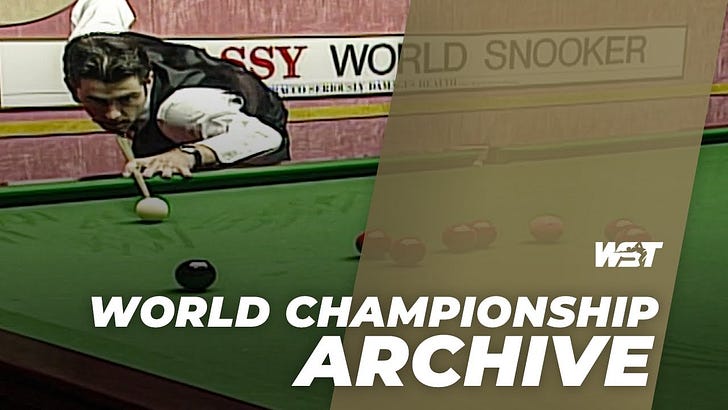
But the defining feature of her essay is a philosophical curiosity that takes aim at snooker’s greatest performer, Ronnie “The Rocket” O’Sullivan. I don’t have Rooney’s verbal gifts, and a video is worth a million words, so if you want to know what he can do and you have five minutes to spare, watch this:
What is the nature of athletic skill? Rooney asks the reader to imagine throwing a ball:
You try to make a throw, and you miss your target. Do you feel that you somehow got the throw right in your mind but that your arm went wrong? Sometimes I suppose you might feel that way—if the ball slipped out of your hand, for instance. But most of the time, it probably just feels like you missed the target. Right? You, your brain, and also your arm and hand, at the same moment, in the same way: you just missed.
There’s a picture from which we have to free ourselves, on which the labour of throwing is divided between mind and body, as though I first intend to move exactly thus-and-so and either succeed in matching my intention—if I miss the target, anyway, blame my mind—or fail to execute my intention properly, in which case the fault lies with my body. This picture is wrong, not just because I don’t or can’t articulate in words the exact trajectory and force of impulse I intend but because I don’t intend anything so precise. I mean to hit the target and rely on the intelligence of my body to make it happen—though that doesn’t mean it’s not my doing if it does.
So far, so sensible. But then we run into O’Sullivan and find ourselves saying something else:
In a 2015 New Yorker profile, Ronnie O’Sullivan was compared to “a savant, able to perceive mathematical solutions without knowing how or why.” In the London Review of Books last year, Jon Day wrote, “Part of Ronnie’s charm is his complete inability to explain how he does what he does.” But it surely takes nothing away from O’Sullivan’s considerable charm to point out that nobody else can explain what he does either.
Indeed, it would be strange if any athlete in any sport could really explain what they do. Certainly we don’t expect them to start theorizing the conservation of angular momentum. And yet we also don’t tend to describe most sportspeople as “savants.” Why not?
Good question! Rooney speculates, briefly, that it’s “because their abilities—throwing, jumping, catching—basically strike us as exaggerations of our own. Watching O’Sullivan’s just seems different.” But I don’t think that’s quite it. It’s rather that we conceive the question, how to pot a ball across a snooker table, as a problem for mathematical solution—and because the physical moves O’Sullivan makes look more like our own than the physical movements of a pitcher throwing at a hundred miles an hour or a hitter swinging in time to hit the pitch. The decomposition of what he does into mind-bending mathematics and more or less mundane execution is difficult to resist.
As Rooney goes on to explain—she calls this another question, but it’s closely related to her first—the computational problem of snooker is extraordinarily hard.
An ordinary phone or laptop has more than enough computing power to find an optimal chess move in almost any given position within a few seconds or less. But for a computer to play snooker, even with a perfectly accurate robotic arm, it would first have to calculate how exactly to strike the cue ball. And to do that, it would need access to a model or engine that could simulate the real-world physics of the table and balls and predict precisely the result of any given shot. That would take quite a bit more computing power than your phone can provide.
At which point, Rooney drops the question “Why we do we call O’Sullivan a savant?” for the question “How does Ronnie O’Sullivan do what he does?” Cognitive scientists propose that we have a kind of “mental physics engine” that allows us to “roughly simulate problems like throwing a ball at a target”—sacrificing mathematical accuracy for processing speed. But this can’t be how The Rocket works, since his accuracy is Newtonian and his speed prodigious.
Rooney ends by waxing philosophical. How does O’Sullivan do it?
Ludwig Wittgenstein posed the same question another way: “Calculating prodigies who get the right answer but cannot say how. Are we to say that they do not calculate?”
I loved the essay, both for its writing and for its argumentative rigour. But perhaps it is not quite Wittgensteinian enough?
The question “How does O’Sullivan do what we does?” can be asked in many ways. One of them speaks to the cognitive scientist: what are the psychophysical mechanisms by which his snooker-playing operates? But when we watch a video of The Rocket and ask, in awe, “How does he do that?”, I don’t think our incomprehension would be met by advances on the model of the mental physics engine.
I suspect we are asking less about mechanics than metaphysics: “How is it possible?” is a question philosophers ask about knowledge, free will, or justice. One of my few rules of method in philosophy is that the question of possibility presupposes an argument that it isn’t possible, whatever it might be. Our task is to reconstruct the hidden argument and explain where it goes wrong. This task is therapeutic in Wittgenstein’s sense: our aim is to free the fly from the fly-bottle.
Rooney’s questions—“Why do we call O’Sullivan a savant?” and “How is what he does even possible?”—are, I think, related to one another. A picture holds us captive. We have an idea of how one would have to do what he does—by mathematical physics and physical translation—and that can’t be how he does it. So it can’t be done.
We’ve been snookered and our task is to escape the trap, a task that involves more than mere description: we have to uproot the sources of our puzzlement in misconceptions of mind and body, as Rooney indicates.
Or we could simply leave it be. After all, why rob ourselves of the wonder we experience when we watch The Rocket play?


I just read Rooney's essay last night. She's a gem. Every one of her essays is delightfully written and deeply thought provoking. In this case, perhaps the mystery stems from our desire, fueled by a few centuries of the scientific method, to explain everything with numbers. The physicist understands knowledge to be what can be described by mathematics. If a phenomenon can't be described with formulas and equations, it can't be "known". Is O'Sullivan's ability thus outside of knowledge, do we just need better equations, or is our concept of what knowledge is too limited? In which case we are, as you say, back to metaphysics.
This reminded me of Hazlitt's Indian Juggler. Think there's also a question of the relation between grace and necessity (btw, Hurricane Higgins was the dude).
Snooker is also, İ think, used as a metaphor in economics: agents act "as if" they knew all the variables/permutations/equations. There is no "why".
Also, very interesting article in the TLS called 'Snookered' on why women don't go for philosophy or economics. What if they can take a step back from 'the table' and see it's pointless (skill without virtues)?