
Pranksters vs. Autocrats

For no specific reason, I had occasion to revisit recently a piece I wrote for the New Statesman in 2021, about the political efficacy of humour, “Can Comedy Change the World?” Acknowledging an affinity between comedy and critique—for the anthropologist Mary Douglas, “[a] joke is a play upon form [that] affords opportunity for realising that an accepted pattern has no necessity”—I was less optimistic than some:
“Under the tyrannies of Hitler in Germany and of Stalin in the Soviet Union, humour was driven underground,” Arthur Koestler wrote in the 1970s. “Dictators fear laughter more than bombs.”
It’s an inspiring thought—that comedy is consequential, a clear and present danger to the despot. Alas, there’s not much evidence that it’s true. Do autocrats fear laughter? Or do they simply dislike being laughed at and have the power to put a stop to it?
The rest of the essay asked what comedy can do, if not strike fear in the autocrat’s heart. My answer was “not nothing”: “The social value of comedy has as much to do with enlightenment and solace as reform.” Laughter can honey the bitter wormwood of social critique, helping us to face bleak truths, and it can console without denying or diminishing human suffering.
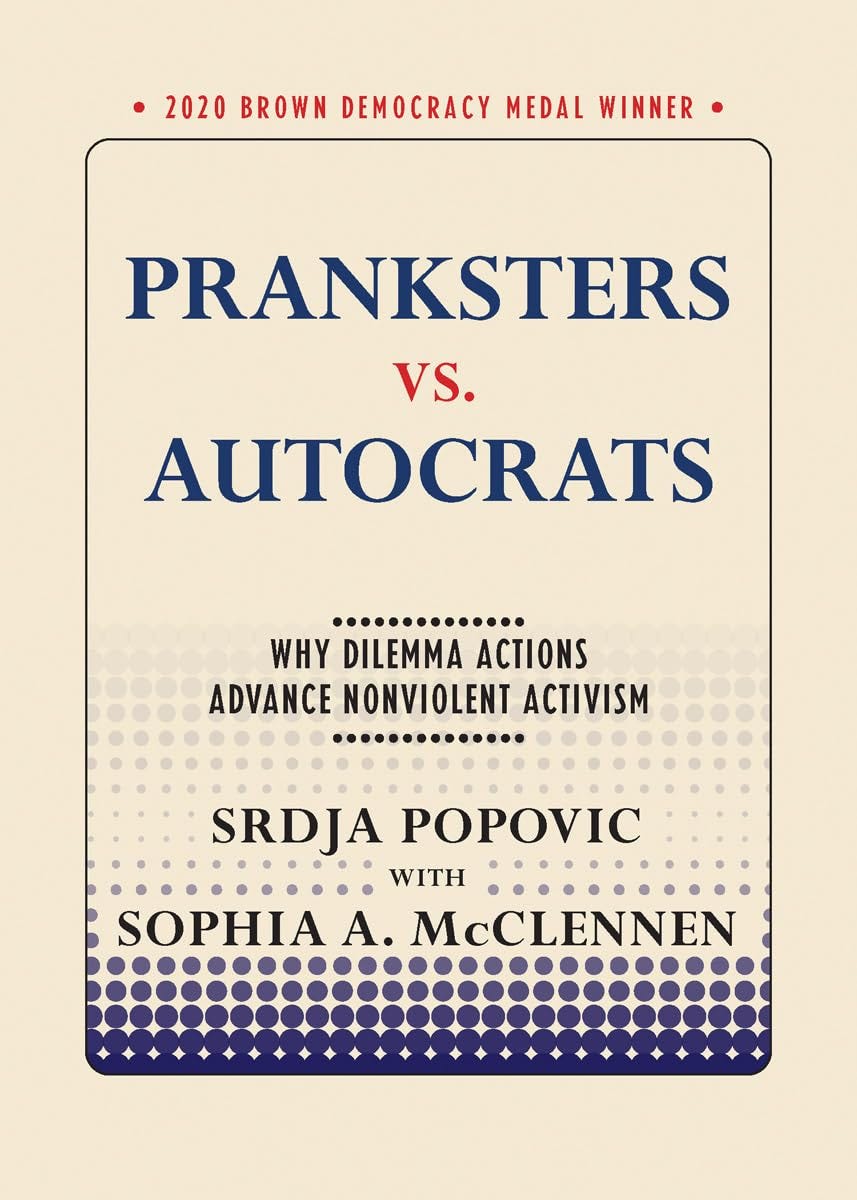
I still believe in comedy as consolation, but I’ve come to think I was too quick to dismiss its power to effect real change—not through satire but non-violent direct action. In Pranksters vs. Autocrats, Srđa Popović and Sophia A. McClennen argue for the efficacy of “laughtivism”: protest in which humour puts dictators in impossible dilemmas.1
Srđa Popović was a leader of the Serbian student movement that helped oust Slobodan Milošević. He is now the director of CANVAS, the Centre for Applied Nonviolent Action and Strategy, which has worked with pro-democracy activists around the world. The focus of Pranksters vs. Autocrats is the “dilemma action,” where the opponent “must either (a) grant a nonviolent movement’s demand, or (b) act in a way that sacrifices some of its own support and damages its public image.”
One way to build support for a dilemma action, and to make its violent suppression more unpopular and less effective, is to make it funny:
One of our most successful dilemma actions was called “Dime for Change.” My fellow Otpor activists painted a picture of Slobodan Milošević’s face onto a large petrol barrel in a downtown shopping area in the capital city of Belgrade. People were invited to throw a few “dimes for change” into the barrel and buy themselves a chance to hit the painted portrait of our dear president with a bat. Soon curious bystanders lined up for a swing. People started to stare, then to point, then to laugh.
The police were in a bind. Since the protest’s organizers were not visible, they could either “arrest the people lining up to smack the barrel—[including] parents with children—or they could … arrest the barrel itself.” They chose the second path, and the photograph of “two policemen dragging an old barrel with Milošević’s face to [a] patrol car” became iconic: “It told anyone who so much as glimpsed it that Milošević’s feared police had been turned into a punchline.”
The stunt has precedents, though the immediate outcome sometimes goes the other way. In 1982, the Polish Solidarity movement staged a protest against government propaganda by loading TVs into wheelbarrows and pushing them through the streets at dusk, when the broadcast news was on the air. Neighbours would great neighbours to share the joke. Beginning in Swidnik, the action spread to other Polish towns—and the government cracked down, moving the state-imposed curfew from 10:00pm to 7:00pm, ending the laughter but enraging even those who had not taken part in it. Support for the regime was undermined.
Perhaps my favourite case of laughtivism in Pranksters vs. Autocrats is the 2014 treatment of a neo-Nazi march in the German town of Wunsiedel, which took the form of an “involuntary walk-a-thon”:
The organizers drew chalk markers on the pavement marking the starting point, halfway point, and finish line. Residents and local businesses pledged to donate ten euros for every meter the white supremacists marched to a group called EXIT Deutschland, which is dedicated to helping people leave right-wing extremist groups. People came out to cheer the marchers the day of the event, flanking the route with signs that read, “If only the Fuhrer knew!” and “Mein Mamph!” (or “My Munch”) by a table of bananas offered to the walkers. This turned the marchers into involuntary resistors of their own cause…
Popović and McClennen have ideas about the theory, as well as the practice, of laughtivism: “one of the critical reasons why laughtivism is so effective.” they contend, “is that it helps point out the situational irony of abusive power.”
When a dictator claims that he is operating in the public’s interest by repressing them, that situation is ironic, even if it isn’t funny. The situation is ironic because it holds deep structural contradictions. … Once a resistance movement learns how to analyze the ironic contradictions of a repressive system, they can then find creative and entertaining ways to expose [them].
This argument is in congruity with the incongruity theory of humour: not that dissonance is sufficient for being funny, but that it’s a condition of humour, and the work of comedy is to find amusement in it.
It’s a bitter irony that policies enforced by populist dictators often hurt the very people who gave them power. Laughing at this paradox could be cruel, a nihilistic Schadenfreude. But Pranksters vs. Autocrats gives hope for a comedy that mocks the contradictions it makes manifest, not their victims, that builds unity in derision, that fuels protest comical enough that to suppress it invites ridicule.
Sweet irony that the ironic clash of populist and populace should lend itself to the deflating comic bathos of the clown.
Thanks to Sakinah Munday for pointing me to this inspiring book.
Just finished another reread of repent Harlequin
https://www.d.umn.edu/~tbacig/cst1010/chs/ellison.html
Coincidence?